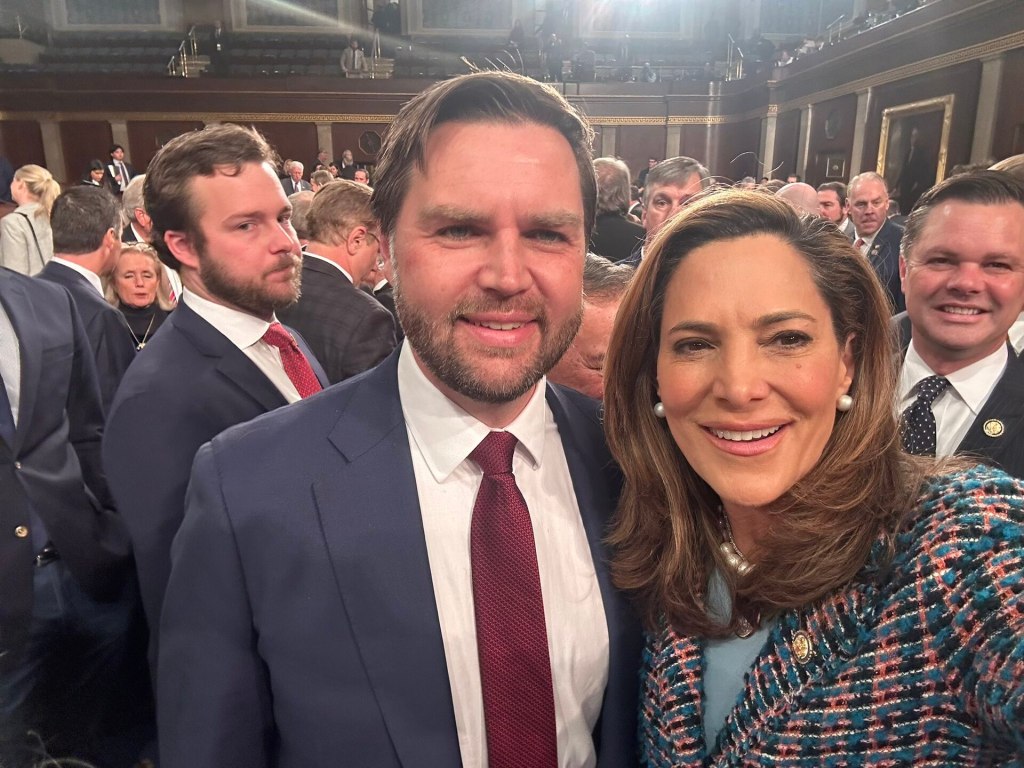
Photo: Cuban American Rep. María Elvira Salazar (R-FL) and Vice President J.D. Vance in a selfie shared on X.
The histories of Cuba and Puerto Rico have been intertwined since the late 19th century, when both nations fought for liberation from Spanish colonial rule. The United States entered the conflict in 1898 and took possession of both islands. Cuba gained its independence in 1902, while Puerto Rico remained under U.S. control.
Later, with the triumph of Fidel Castro in 1959, Puerto Rico became a refuge for thousands of Cubans fleeing castroism. Many of them profoundly enriched Puerto Rico’s cultural landscape.
Cuban-American Representative María Elvira Salazar, from Miami-Dade County’s 27th District, was born in Miami to exiled parents but grew up in Puerto Rico, according to her public biography. Understandably, she maintains an emotional connection to Puerto Rico. However, understanding is not the same as justifying.
Puerto Rico has experienced particularly questionable governance since the 2017 hurricanes, which exposed the federal government’s negligent response and the corruption of then-Governor Ricardo Rosselló, whose chat scandal and warehouses full of expired supplies led to his destitution in 2019.
The hurricane-induced instability compounded the growing discontent with the traditional two-party system, which was responsible for the gradual economic decline the island had been experiencing since 2006 and which resulted in the second mass exodus to the United States in Puerto Rican history.
In that climate of discontent, new political movements have emerged and, with considerable effort, have gathered enough signatures for party certification. Faced with this progress, the traditional parties—the pro-Commonwealth and the pro-statehood parties—responded with a fear campaign.
It was in this context that Rep. María Elvira Salazar intervened with a social media video endorsing current Gov. Jenniffer González’s pro-statehood candidacy, warning, without evidence, that communism threatened Puerto Rico. González won, and her administration follows the same problematic patterns as her predecessors.
As far as we know, no politician of Puerto Rican origin on the mainland has dared to tell the people of Puerto Rico how to vote publicly. There are expressions of support from here, but not fear-mongering campaigns like Salazar’s. Her intervention wasn’t only inappropriate but also misinformed and manipulative.
The comparison she attempts to make between Cuba in 1959 and Puerto Rico today lacks rigor. Cuba was a sovereign republic when Fidel Castro expropriated U.S. interests. Puerto Rico, on the other hand, has been under the jurisdiction of the U.S. Congress since 1898. No one can expel the U.S. from Puerto Rico as happened in Cuba.
Furthermore, Puerto Rico has a Constitution, as established by the Puerto Rico Federal Relations Act (1950). Independence, should it ever occur, would require approval by the U.S. Congress through the repeal of that law. And no one in Washington wants Puerto Rico to become a new problem in the Caribbean due to poorly planned independence.
Moreover, Puerto Ricans have been U.S. citizens since 1917. There has never been a precedent of a territory with U.S. citizenship achieving independence. That doesn’t mean it’s impossible, but it’s uncharted legal territory and would be complex.
Independence doesn’t automatically lead to authoritarianism or communism. Since the 1960s, Caribbean nations like Jamaica, Trinidad and Tobago, Barbados, and Dominica have achieved sovereignty without resulting in dictatorships.
If Puerto Rico’s statehood is so desirable, why does Salazar never propose it for post-Castro Cuba? The ultimate goal of the Cuban-American leadership has been to overthrow the dictatorship, but without a plan for Cuba afterward.
The closest case of independence is that of the Philippines, but its inhabitants were not U.S. citizens; rather, they were “U.S. nationals,” meaning that they owed allegiance to the country without having full rights. They could live and work in the U.S., but couldn’t vote, serve on juries, or access certain federal jobs. Therefore, Philippine independence was easier for the U.S. legally.
Rep. Salazar’s problem is that she knowingly used the wrong frame of reference to provoke electoral fear in Puerto Rico, which isn’t a sovereign republic with control over its military, foreign policy, and currency.
María Elvira Salazar’s statements are an example of the tendency in certain sectors of the Cuban exile community to assume that their trauma with communism is the only interpretive lens for the political situation in Puerto Rico, regardless of the legal differences between the two islands.
 Internal Frontiers
Leave a comment