
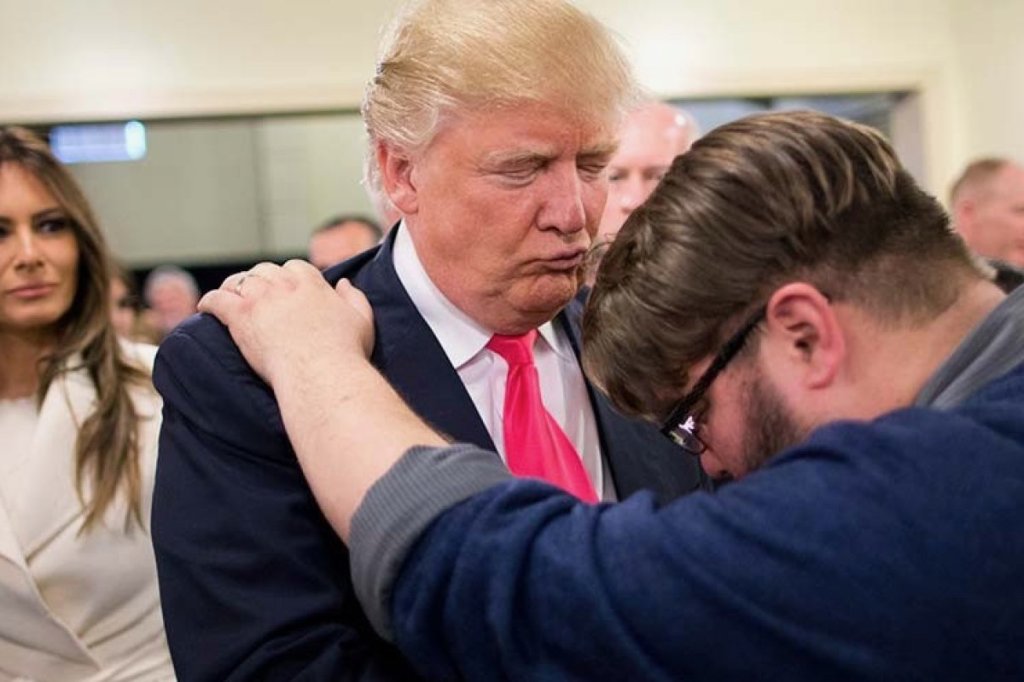
Photo: Evangelical leaders praying for Trump. Source: University of Chicago Divinity School
There is a viral video on social media of Puerto Rican pastor Iris N. Torres, leader of a Pentecostal megachurch in Bayamón, endorsing Donald Trump’s immigration policies and questioning the “uproar” over immigration raids in Puerto Rico and threatening to notify immigration of undocumented immigrants.
Her remarks weren’t only inflammatory but also a statement from her position of privilege. As a Puerto Rican born with U.S. citizenship, Torres has never had to face interviews with USCIS, ICE detentions, or the fear of deportation. She speaks from a position protected by her U.S. passport and focuses on legality, dismissing the human suffering involved in migration.
Torres’s stance isn’t an isolated case but rather part of a conservative theological trend in the United States that shifts Christianity’s ethics from compassion to legal obedience. Instead of prioritizing the vulnerable, many Christian leaders spiritualize the law, even when those statutes have been historically oppressive.
The legal system isn’t moral or ethical by definition. For example, slavery and segregation were legal. The same logic applies to the unequal relationship between the United States and Puerto Rico. U.S. laws uphold the island’s unfair treatment.
When the law codifies oppression, that doesn’t mean it’s right. For many people, the law becomes an idol. In that case, faith ceases to be a refuge and becomes a tool of control.
According to the Gospel of Matthew (2:13–15), Jesus was a displaced child who crossed a border with his parents to escape Herod’s death warrant. Egypt wasn’t Judea; it was another country. If many Christians take this narrative seriously, it would be difficult to defend a theology that legitimizes contempt for migrants.
After the controversy, pastor Torres retracted her statement on the program “Early Morning.” She claimed the media reported her words out of context and that she intended to help people legalize their status.
She acknowledged that she had mentioned notifying the authorities, though she later asserted she wouldn’t. She insisted that she can’t be part of “any kind of illegality.” The retraction doesn’t deny her expressions; it softens them for damage control.
During a course on conflict transformation that I took at Boston University’s School of Theology, Professor Judith Olsen stated that “Christianity is a source of both peace and conflict, justice and oppression, unity and division.” That statement summarizes the never-ending tension within Christianity. Faith can liberate or oppress; it can stand with the persecuted or align itself with the persecutor.
My experience at Boston University wasn’t negative. The institution awarded me merit scholarships and stipends for my leadership in a low-income neighborhood in Boston. I appreciate those awards. However, the course made me realize that I couldn’t tolerate Christianity’s ambivalence and its capacity to both welcome and exclude. I left not because of a faith crisis, but intellectual clarity.
What is troubling isn’t only what Torres said, but the place from which she said it. When a pulpit ceases to be a space of refuge and becomes a mouthpiece for punitive policies, the church stops offering comfort and begins to validate fear. And that’s no longer unethical involuntarily; it’s a decision.
 Internal Frontiers
Leave a comment